
Collateral Swap: DashsWallet vs the Official Aave Dapp
Same wallet, same Aave v3 position, same WBTC to USDC collateral swap, run in both interfaces. The official dapp quoted a worse price, signed a looser slippage floor and charged 27x more to execute. Every number below is read off the two screenshots.
First: what does "swapping collateral" mean?What a collateral swap isswapCollateral: the mechanism
Imagine you left a gold watch at a pawn shop to borrow cash. One day you decide you would rather leave actual cash in its place, because the price of gold keeps swinging.You have WBTC supplied as collateral on Aave with an open loan against it. You want out of the BTC exposure without closing the loan, which means replacing the collateral with USDC while the debt stays open.The operation takes a flashLoanSimple in the destination asset, swaps the source collateral through an adapter, calls supply() of the destination on behalf of the user, withdraws the permit-authorised source collateral and settles the flash loan plus premium.
To do that, someone has to sell the watch, take the cash and leave the cash in its place, without ever leaving the pawn uncovered. If it goes uncovered, the shop owner keeps everything.Doing it by hand would mean withdrawing the WBTC first, which drops your Health Factor and can get you liquidated, then selling on a DEX and re-depositing. A collateral swap does all three steps in a single transaction, using a flash loan so the position is never uncovered.It is atomic: any failing leg reverts the whole transaction, so the position is never under-collateralised mid-flight. This is why the swap leg has to be priced and bounded up front rather than executed opportunistically.
In DeFi it works the same way. The watch is your Bitcoin deposited on Aave, the cash is USDC, and the shop owner is the protocol, which liquidates your position if it ever goes uncovered. All of it happens in one automatic operation. Which leaves exactly one question: who sells your watch better?The protocol is the same on both sides: Aave v3. What changes is who executes the sale of the WBTC, and that is precisely where value leaks.The official dapp adapter consumes calldata from a single ParaSwap route. DashsWallet quotes several aggregators in parallel, compares amountOut net of cost and only then builds the calldata. Same adapter surface, different routing. The execution delta scales with notional; the cost delta is fixed per transaction.
Where your money leaks outThe three leak pointsDecomposing the delta
Every swap has three holes money can disappear through. Here is each one, on both sides.Execution price, slippage tolerance and operating cost. Only the third one shows up on screen as a fee.Three independent components. Only the first is proportional to notional; the other two are fixed per transaction.
The price your asset sells forExecution priceExecution price (bps)
Nobody charges you anything here. They simply sell your Bitcoin for less than it could have gone for. You never notice, because you have nothing to compare it against.It never appears as a fee. It is the gap between the route the dapp uses by default and the best route available at that same instant.Implicit cost, invisible on the receipt. The official dapp consumes a fixed ParaSwap route; with no competing quote there is no baseline to measure the spread against.
- Official Aave dapp
- 84,121.23
- DashsWallet
- 84,395.52
Plus 32.6 bps. The router compared the integrated aggregators and settled on OpenOcean, 15 bps ahead of the runner-up. Scales linearly with notional.
The "margin of error"Slippage toleranceminAmountOut and MEV surface
This is how much less you agree to receive if the price moves between your click and the operation landing. The looser that margin, the more room there is for bots to cut in front and pocket the difference.It is the floor you sign. A 1.09% tolerance authorises the transaction to settle up to 1.09% below quote, and that slack is exactly what a sandwich bot captures.It sets minAmountOut. The gap between quoted price and signed floor is the ceiling on value extractable by a searcher in the same block.
- Official Aave dapp
- 1.09%
- DashsWallet
- 0.37%
Minus 72 bps of surface. Both are automatic; DashsWallet calibrates against the real liquidity of the chosen route instead of applying a single default.
The cost to executeCosts and feesFixed cost per transaction
The toll for making the operation happen. This is the only one actually written on screen, and even so it is 27 times larger on the Aave side.The dapp reports $0.15 of costs and fees as a single figure. DashsWallet itemises it: network, platform fee and flash loan premium.$0.15 aggregated and undisclosed, against $0.0055 of network at 284.29 gwei plus 0 bps of fee plus $0.00 of premium.
- Official Aave dapp
- $0.1500
- DashsWallet
- $0.0055
Minus $0.1445 per transaction. Fixed cost: dominant on small operations, diluted on large ones. Plus $0.02 of contract cashback.
The two screens, side by sideSide-by-side evidenceCapture of both interfaces
These are the actual screenshots of both screens, on the same wallet and the same position. Compare them yourself.Same wallet, same position at HF 1.81, same pair and same size. The card figures are read straight off the screenshots.Unedited captures. Every value below is read literally from each application UI.
Official Aave Dapp
Native interface, fixed ParaSwap route
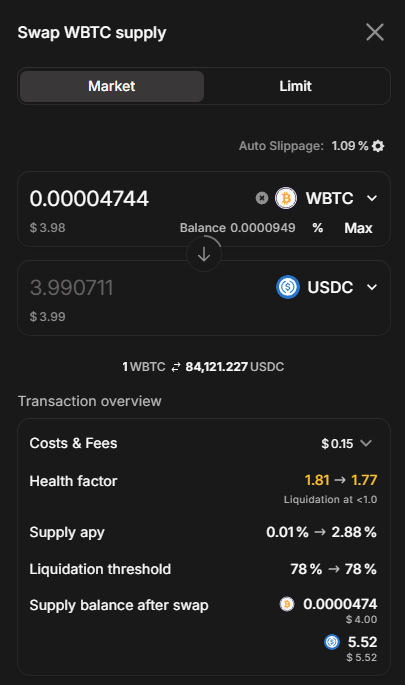
- WBTC sale price
- 84,121.227 USDC
- Who picks the route
- Fixed route (ParaSwap)
- Slippage tolerance
- 1.09%
- Costs and fees
- $0.15
- Cashback
- $0.00
3.990711 USDC
Floor signed with 1.09% of slack, plus $0.15 of cost and nothing returned.
DashsWallet
Multi-aggregator router with cashback
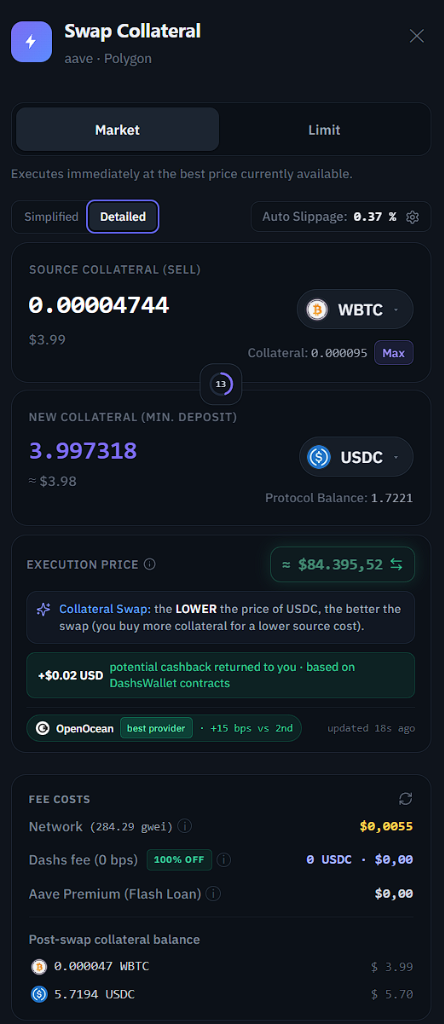
- WBTC sale price
- 84,395.52 USDC
- Who picks the route
- Best of N (OpenOcean)
- Slippage tolerance
- 0.37%
- Costs and fees
- $0.0055 + 0 bps
- Cashback
- +$0.02
3.997318 USDC
Plus 0.006607 USDC guaranteed, with $0.1445 less cost and $0.02 back in the wallet.
What this is worth to youProjection for your position sizeParametric projection of the delta
The test swap was only $4. Drag the slider to see what the difference is worth at the size you actually trade.Two components: one proportional (execution price) and one fixed (network cost and fee). Drag to see the weight of each.Gain equals notional times 0.00326 plus $0.1445 fixed. The fixed term dominates below roughly $45 of notional; above that, the proportional term does.
$4,900
Linear projection from the delta measured on 2 October 2026. It excludes the $0.02 of cashback observed, and excludes the tighter slippage: in the worst case, the 72 bps lower tolerance protects a further $35.28 at this size. Protection against the worst case is not a realised gain, so it is never added to the total. Real results vary with liquidity, pair and network.
Raw numbers and methodology
Everything above comes from here, including the limits of the test.
| Metric | Aave dapp | DashsWallet | Delta |
|---|---|---|---|
| Input (WBTC) | 0.00004744 | 0.00004744 | — |
| Execution price (USDC/WBTC) | 84,121.227 | 84,395.52 | +274.29 (+32.6 bps) |
| Slippage tolerance | 1.09% | 0.37% | −72 bps |
| USDC guaranteed (minimum) | 3.990711 | 3.997318 | +0.006607 |
| Costs and fees reported | $0.15 (aggregated) | $0.0055 | −$0.1445 |
| Platform fee | not itemised | 0 bps (100% off) | — |
| Flash loan premium | not itemised | $0.00 | — |
| Cashback | $0.00 | +$0.02 | +$0.02 |
| Health Factor before | 1.81 | 1.81 | — |
| Network / gas price | Polygon | Polygon, 284.29 gwei | — |
| Post-swap USDC balance shown | 5.52 | 5.7194 | see note below |
The two screens show different post-swap balances, 5.52 against 5.7194 USDC, partly because the USDC already supplied differed at capture time: 1.5293 against 1.7221. For that reason we do not use the final-balance difference as a measure of advantage, since it mixes the result of the operation with what was already in the position. The number that counts is the swap delta itself, plus cost.
How it was run
Same wallet, same Aave v3 position on Polygon, same pair and same input size of 0.00004744 WBTC. Both screens were opened within the same market window and captured unedited. The execution layer is the only variable deliberately changed.
What is actually being compared
The fair comparison is the swap leg: how much USDC each interface guarantees to deliver from the same WBTC input, 3.990711 against 3.997318. On top of that we add the operating cost, which both screens report explicitly.
Decomposing the gain on this operation
At $3.99 of notional: execution contributes +0.006607 USDC, cost contributes +$0.1445 and cashback +$0.02, for roughly $0.171 in total, about 4.3% of the operation. Most of that is fixed cost, which does not scale. That is why the calculator splits the two terms instead of advertising a single headline percentage.
Slippage is not counted in the total
The tighter tolerance of 0.37% against 1.09% is protection against the worst case, not a realised gain. The protected amount is shown separately and never added to the gain.
Limits of this test
One operation, one pair, one network, one instant. Execution price depends on liquidity and pair depth at the time; network cost depends on the gas price, 284.29 gwei at capture. The winning provider varies per operation; here it was OpenOcean, 15 bps ahead of the runner-up. None of these figures is a guarantee of future results.
Why it happens
It shops around for the best priceMulti-aggregator routingMulti-aggregator routing
Instead of always using the same shop, it asks several at once and sells where they pay most. Here that meant $84,395 instead of $84,121.Quotes the integrated aggregators in parallel and settles on the best net result. In this test: OpenOcean, 15 bps ahead of the runner-up.Competing quotes selected by amountOut net of cost. The official dapp consumes a single ParaSwap route with no baseline.
It closes the door on botsCalibrated slippageCalibrated minAmountOut
It tightens the margin of error to 0.37% instead of 1.09%, leaving far less room for someone to take advantage of your order.0.37% against 1.09%: 72 bps less slack available for a sandwich bot to capture.Tolerance derived from the real liquidity of the chosen route rather than a single default, lowering the ceiling on extractable MEV in the block.
No fee, and it pays some backZero bps plus cashbackZero fee plus contract rebate
Platform fee: zero. And $0.02 came back to the wallet after the operation.Protocol fee at 100% off, and $0.02 of cashback credited by the DashsWallet contracts.0 bps of integrator fee and a rebate settled by the contract; flash loan premium at $0.00 in this capture.
It costs 27x less to runLean on-chain costCost per transaction
$0.0055 against $0.15. That is the same cost regardless of how large your operation is.$0.0055 of network against $0.15 reported: a fixed cost, decisive on small and frequent operations.$0.0055 at 284.29 gwei on Polygon against $0.15 aggregated; an absolute saving of $0.1445 per transaction.
Frequently Asked Questions
Q1.Is DashsWallet always cheaper than the official Aave dapp?
No, and this page does not claim that. It documents one collateral swap run on the same position on 2 October 2026 on Polygon. Execution price depends on the liquidity of the pair at that moment and the winning aggregator varies per operation. The structural differences, competing quotes, calibrated slippage and zero platform fee, apply to every swap; the exact size of the gain does not.
Q2.Why not compare the final collateral balance on both screens?
Because the USDC already supplied differed between the two captures, 1.5293 against 1.7221. Comparing final balances would mix the result of the operation with funds that were already in the position. The honest comparison is the swap leg: 3.990711 against 3.997318 USDC guaranteed from the same WBTC input.
Q3.What does slippage tolerance actually change for me?
It sets the floor you authorise. A 1.09% tolerance lets the transaction settle up to 1.09% below the quoted price, and that slack is what a sandwich bot can capture. A 0.37% tolerance leaves 72 bps less room. It is protection against the worst case, not a guaranteed gain, which is why it is reported separately and never added to the total.
Q4.Does the gain scale with the size of my position?
Only partly. The execution-price advantage of 32.6 bps is proportional and scales with notional. The cost advantage of $0.1445 is fixed per transaction, so it dominates small operations and dilutes on large ones. The calculator on this page keeps the two terms separate for that reason.
Q5.Can I reproduce this test myself?
Yes. Open the same collateral swap in both interfaces on your own position, at the same moment, and compare three things before signing anything: the minimum amount out, the slippage tolerance and the total cost. You do not need to trust the figures on this page.
Run the same test on your own position
You do not need to take our word for it. Open both screens with your position, compare minimum output, slippage tolerance and total cost, and only then sign.